
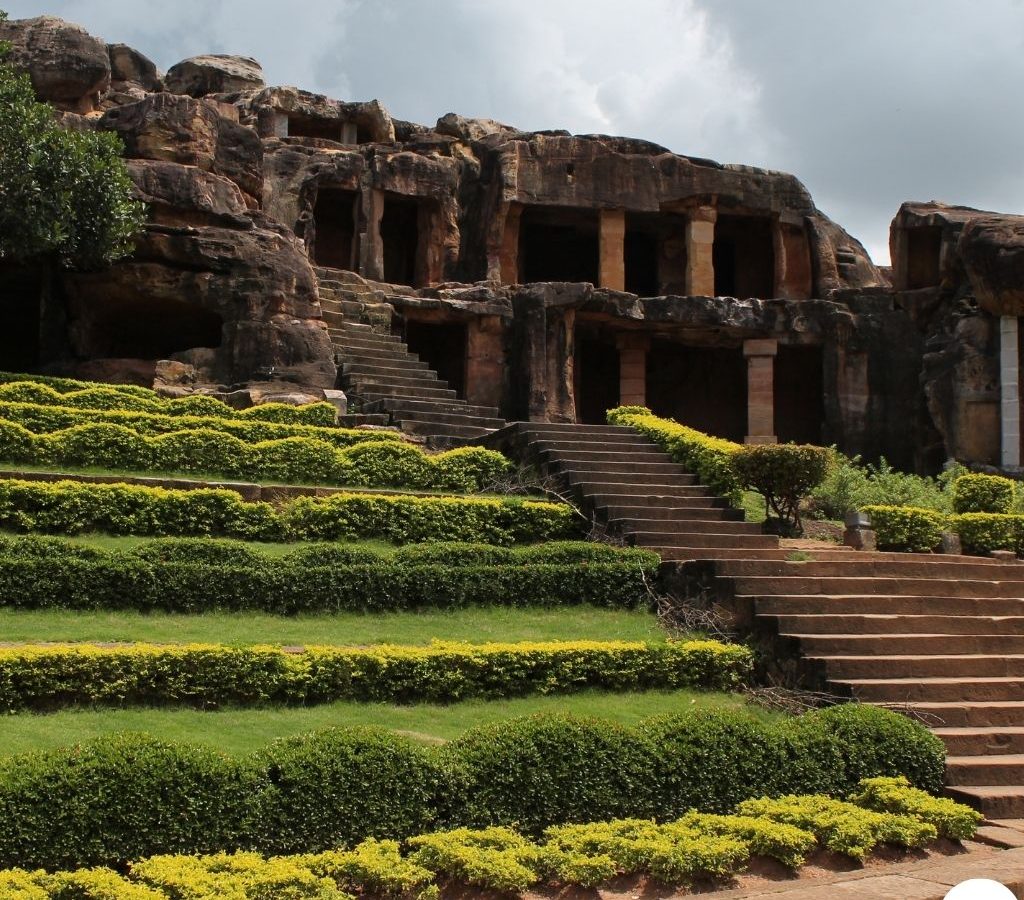
➡️Udayagiri (Sanskrit: उदयगिरि), meaning “Hill of Sunrise”, is a name shared by several ancient sites across India, renowned for their archaeological, historical, and religious significance. These sites, scattered across states like Madhya Pradesh, Odisha, Andhra Pradesh, Tamil Nadu, and Karnataka, feature rock-cut caves, hill forts, and ancient monuments that date back to early dynastic periods of Indian history.
➡️Each Udayagiri site represents a unique cultural and historical legacy — from the Gupta-era caves near Vidisha (Madhya Pradesh) showcasing the finest Hindu iconography, to the Jain rock-cut sanctuaries near Bhubaneswar (Odisha) carved under the reign of King Kharavela in the 2nd century BCE. Together, they form a remarkable testament to India’s early architectural genius and spiritual diversity.
The term “Udayagiri” often refers to:
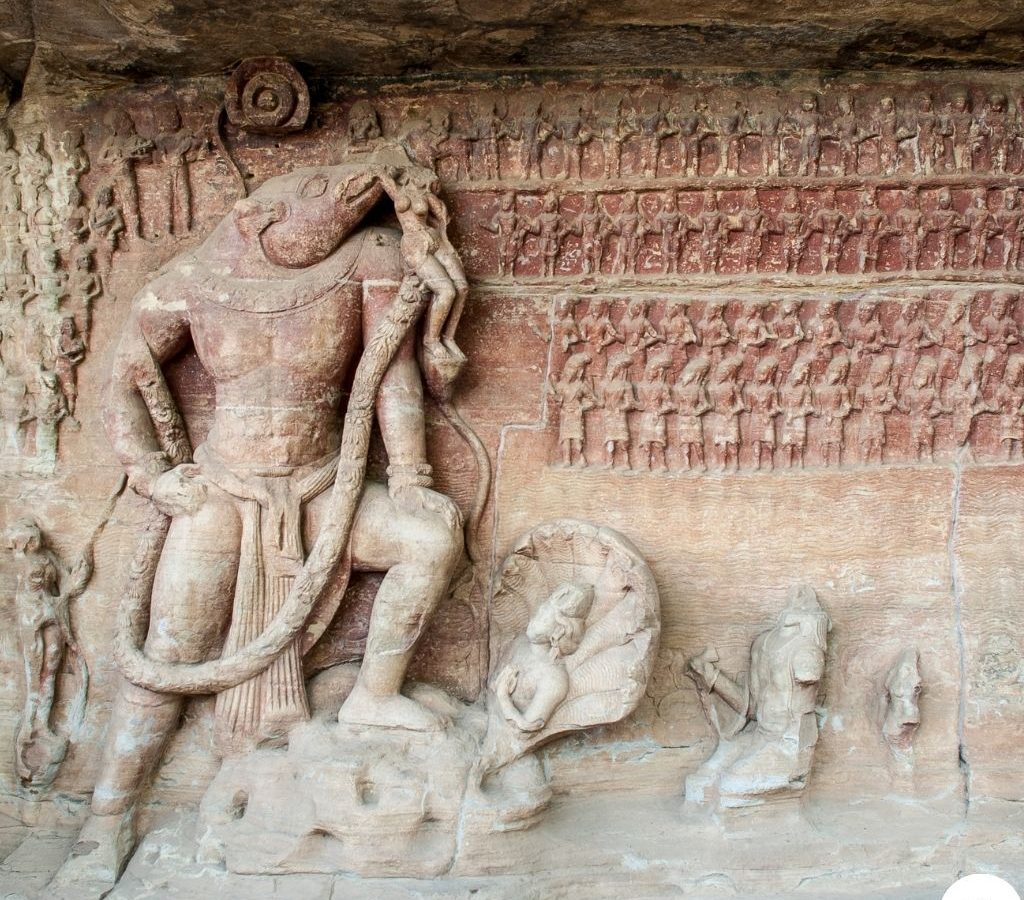
- The Udayagiri Caves in Madhya Pradesh, celebrated for the monumental Varaha (Boar) Avatar sculpture of Vishnu.
- The Udayagiri and Khandagiri Caves in Odisha, among the earliest examples of Jain rock-cut architecture.
- The Udayagiri Fort in Tamil Nadu, a hill fortification from the Travancore era.
- The Udayagiri Fort in Nellore (Andhra Pradesh), and smaller hill regions in Karnataka bearing the same name.
Across centuries, Udayagiri has symbolized a connection between nature, spirituality, and art. Whether as a sacred retreat for monks, a royal center of worship, or a strategic military outpost, Udayagiri remains one of India’s most evocative names in ancient geography and heritage.
Etymology
➡️The word Udayagiri is derived from two Sanskrit terms — “Udaya” (उदय) meaning “sunrise” or “rising”, and “Giri” (गिरि) meaning “hill” or “mountain”. Thus, the literal translation of Udayagiri is “Hill of Sunrise” or “Rising Mountain.”
➡️The name reflects both the geographical position and spiritual symbolism of the sites. Many of these hills are oriented toward the east, where the sun rises, giving rise to the association with dawn, light, and enlightenment — important concepts in Hindu and Jain philosophies.
➡️In ancient Indian texts and inscriptions, the term “Udayagiri” often denoted a sacred hill or high ground used for meditation, sunrise observation, or worship. The name appears in several Sanskrit and Prakrit inscriptions across India, sometimes as a metaphor for spiritual awakening or a place of divine ascent.
➡️Over centuries, different dynasties and religious communities used the name Udayagiri for distinct sites in their territories, reflecting its cultural prestige.
Notably:
🔴In Odisha, the Udayagiri hill was named for its eastern elevation and its association with Jain ascetics who greeted the morning sun during meditation.
🔴In Madhya Pradesh, the Gupta rulers adopted the same name for a hill near Vidisha, likely due to its sacred alignment with sunrise and religious sanctity.
Thus, “Udayagiri” became a recurring toponym in Indian history, symbolizing the union of nature’s light and spiritual enlightenment.
Locations Named Udayagiri
➡️The name Udayagiri has been used for multiple historic and geographic locations across India. Each site, though sharing the same name meaning “Hill of Sunrise,” carries distinct cultural, architectural, and historical importance. These places span different time periods, dynasties, and regions, representing the widespread influence of ancient Indian civilization.
Broadly, the major locations known as Udayagiri include:
Udayagiri and Khandagiri Caves, Odisha
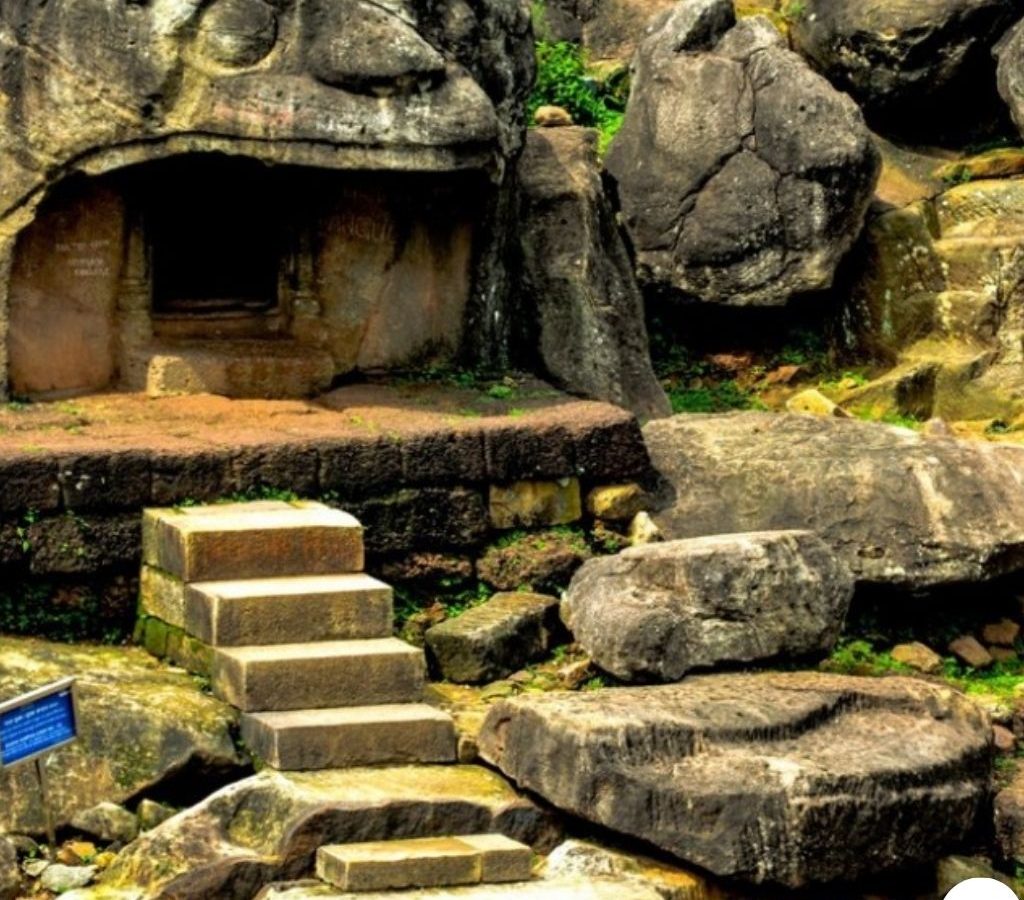
➡️Situated near Bhubaneswar, the capital of Odisha, the twin hills of Udayagiri and Khandagiri house a complex of rock-cut caves dating back to the 2nd century BCE.
➡️Commissioned during the reign of King Kharavela of the Chedi (Mahameghavahana) dynasty, these caves were carved as residential cells for Jain monks.
➡️Udayagiri (meaning “Hill of Sunrise”) and its counterpart Khandagiri (“Broken Hill”) together represent one of the oldest examples of Jain rock-cut architecture in India.
➡️The Hathi Gumpha inscription on Udayagiri is a key historical source about Kharavela’s reign and early Jain patronage in eastern India.
Located near Vidisha, about 13 km from Sanchi and 57 km northeast of Bhopal, the Udayagiri Caves in Madhya Pradesh are a group of 20 rock-cut caves dating to the early Gupta period (4th–5th century CE).
These caves are among the earliest surviving Hindu cave temples in India and are notable for their monumental sculptures, including the famous Varaha (Boar) Avatar of Vishnu, which symbolizes the restoration of cosmic order.
The site also contains Jain shrines, inscriptions, and early examples of Gupta art, architecture, and epigraphy.
The Udayagiri Fort in Kanyakumari District, Tamil Nadu, was originally built during the rule of the Venad Kings and later rebuilt in the 18th century by Marthanda Varma, the ruler of Travancore.
It served as an important military fortification and training center, notably used by the Dutch commander De Lannoy, who later became an advisor to the Travancore Kingdom.
The fort’s remains—walls, moats, and armory structures—reflect a fusion of native and European military architecture, set against the scenic backdrop of the Western Ghats.
The Udayagiri Fort in the Nellore district of Andhra Pradesh is another significant site, located atop a hill rising about 300 meters above sea level.
It was a stronghold of various dynasties including the Pallavas, Cholas, Vijayanagara rulers, and later the Nawabs.
The fort contains ancient temples, palace ruins, and inscriptions, illustrating its long and layered history as a regional power center in southern India.
In Karnataka, a smaller site named Udayagiri exists near Chikkamagaluru, known for its ancient temples and stone relics.
Though less prominent than its counterparts in Odisha and Madhya Pradesh, this Udayagiri adds to the broader geographical spread of the name, reflecting its enduring religious and cultural resonance in southern India.
Summary of Udayagiri Sites Across India
| State | Type | Period / Dynasty | Main Features |
|---|---|---|---|
| Madhya Pradesh | Rock-cut caves | Gupta Period (4th–5th CE) | Hindu and Jain sculptures, Varaha relief |
| Odisha | Twin rock-cut hills | Chedi Dynasty (2nd BCE) | Jain caves, inscriptions of King Kharavela |
| Tamil Nadu | Fort | 18th century, Travancore Kingdom | Military architecture, De Lannoy’s armory |
| Andhra Pradesh | Hill Fort | Pallava–Vijayanagara Period | Temples, fort ruins, inscriptions |
| Karnataka | Hill site | Early Medieval | Temples, minor archaeological remains |
Udayagiri Caves, Madhya Pradesh
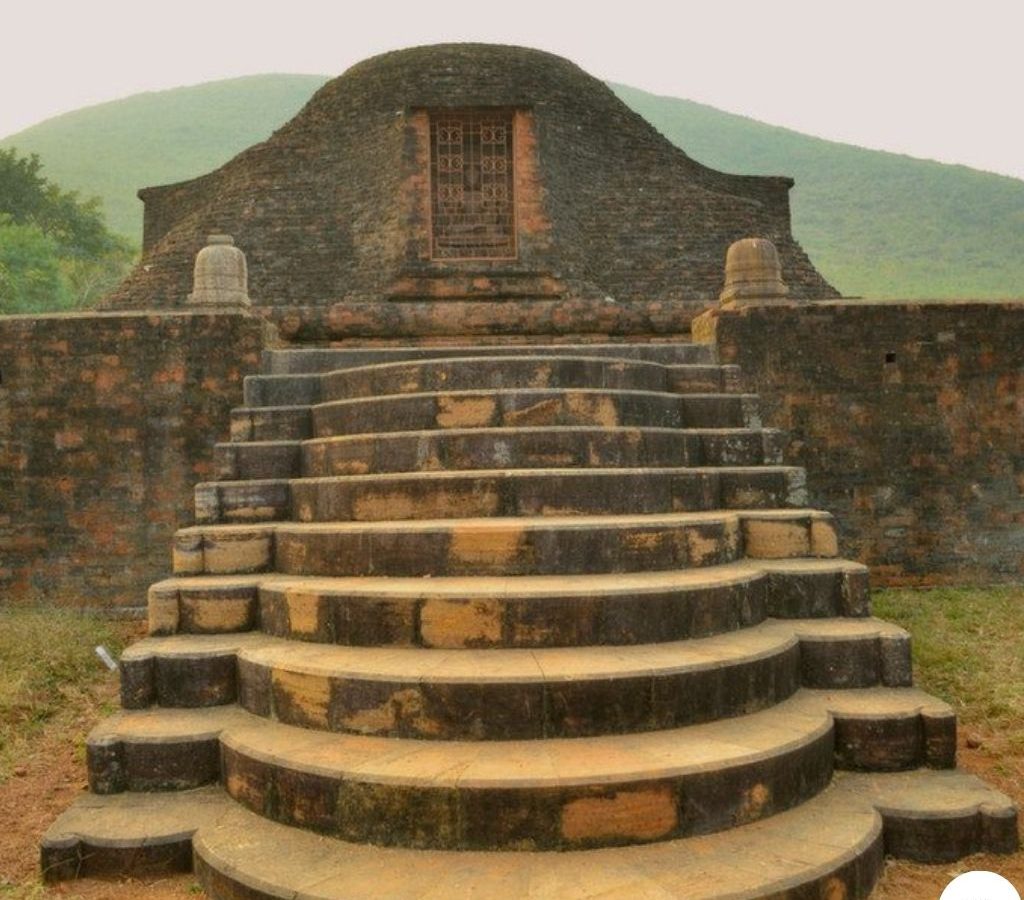
The Udayagiri Caves are a group of rock-cut caves located near Vidisha in the state of Madhya Pradesh, India. Carved during the Gupta period (4th–5th century CE), they are among the oldest surviving Hindu cave temples in the subcontinent and hold immense historical, religious, and artistic importance. The site is particularly renowned for the colossal Varaha (Boar) Avatar sculpture of Lord Vishnu, one of the most celebrated masterpieces of early Indian art.
Location and Geography
Udayagiri is situated about 13 km from Sanchi, 4 km from Vidisha, and approximately 57 km northeast of Bhopal. The caves are carved into a sandstone hill that rises above the plains, close to the Bes River.
The site lies within a natural landscape that blends dense vegetation, rocky terrain, and panoramic views of the Vindhyan region. The caves are primarily cut into the eastern and western slopes of the hill, which were chosen for their symbolic alignment with the sunrise — reinforcing the name “Udayagiri” or “Hill of Sunrise.”
The Udayagiri Caves were excavated during the reign of Chandragupta II Vikramaditya (c. 380–415 CE), one of the most powerful rulers of the Gupta Empire, often referred to as the Golden Age of India.
Inscriptions found at the site indicate royal patronage, and scholars believe the caves served as religious sanctuaries for Hindu and Jain ascetics.
The Udayagiri site reflects the early phase of Hindu temple architecture transitioning from wooden and brick constructions to rock-cut forms. Its caves provide vital evidence of the emergence of Gupta art, characterized by balance, grace, and symbolic depth.
Some inscriptions mention Chandragupta II and refer to his court poet Harishena, linking the site to both royal devotion and literary activity.
There are 20 caves at Udayagiri — Caves 1 to 20 — carved on both sides of the hill. They include Hindu shrines and Jain sanctuaries, though the majority are dedicated to Vishnu and Shiva.
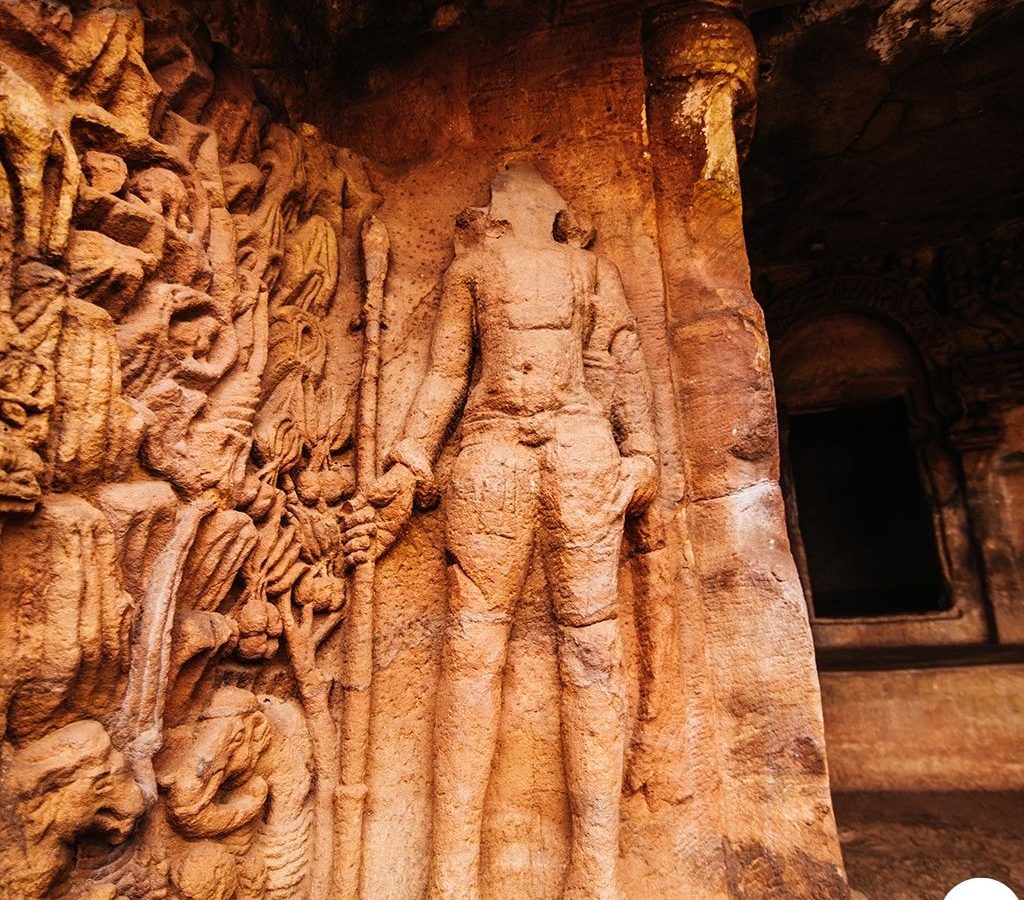
The caves vary in complexity — some are simple rock shelters, while others contain intricately carved facades, pillars, and sculptures.
Key architectural features include:
- Rock-cut sanctums (garbhagrihas) with simple doorframes.
- Sculpted panels depicting mythological scenes.
- Early attempts at temple design, such as Cave 4, which anticipates later structural temples of the Gupta period.
The caves are not uniform in size or design, reflecting both functional diversity and artistic experimentation during this era.
The highlight of Udayagiri is its sculptural art, which vividly portrays scenes from Hindu mythology.
Cave 5 – The Varaha Panel
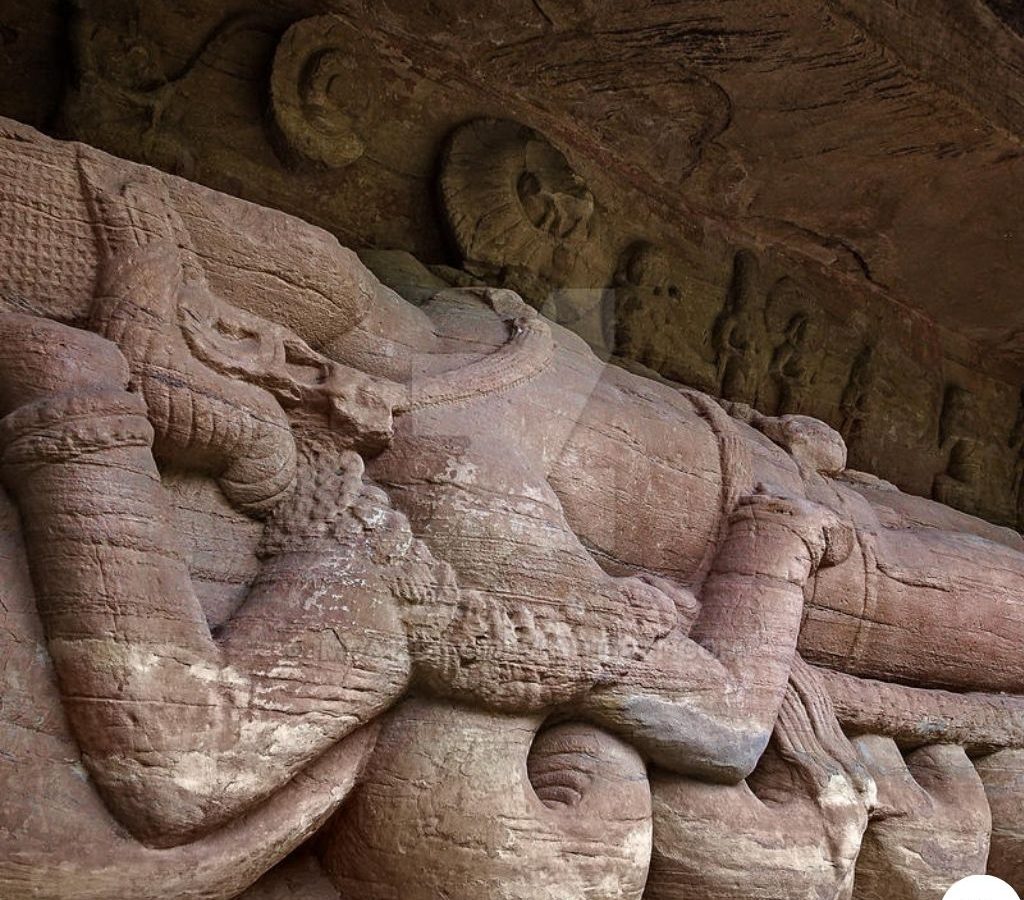
- The Varaha (Boar) Avatar of Vishnu is the site’s most iconic image.
- It depicts Vishnu rescuing the Earth Goddess (Bhudevi) from the cosmic ocean.
- The sculpture, nearly 7 meters wide, shows the deity lifting the Earth on his tusks while surrounded by celestial beings, sages, and deities.
- The composition represents the Gupta ideal of divine power and cosmic order.
Cave 6
- Dedicated to Shiva, featuring images of Durga slaying Mahishasura, Ganesha, andKarttikeya.
- Contains early iconographic forms of these deities.
Cave 7
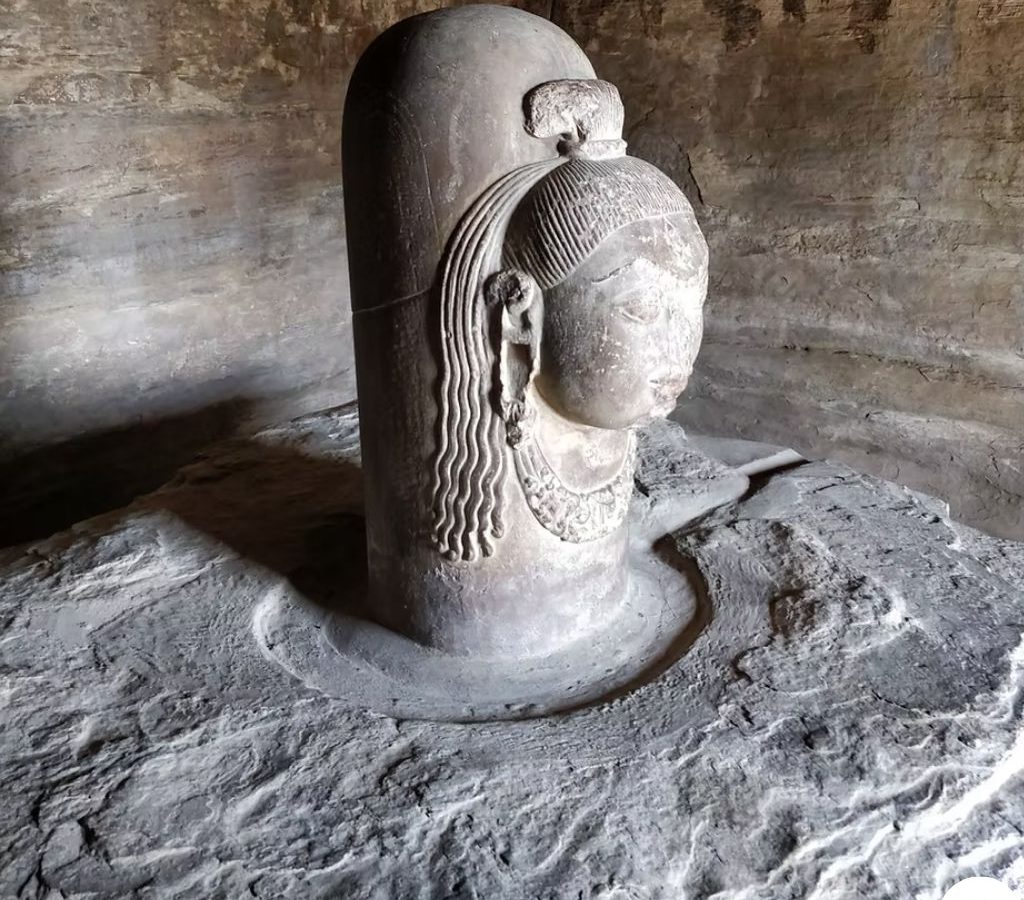
- Houses a Shiva Linga with subsidiary figures.
Cave 19
- A Jain cave, distinguished by inscriptions referencing Tirthankaras, reflecting the religious diversity of the site.
Collectively, the sculptures of Udayagiri showcase the transition from symbolic to fully anthropomorphic representation of deities — a hallmark of Gupta art.
The Udayagiri Caves mark a turning point in Indian religious architecture.
They represent one of the earliest attempts to express Hindu cosmology through stone — merging mythology, symbolism, and political power.
- The Varaha panel symbolizes the victory of order (dharma) over chaos.
- The alignment of the caves with the sunrise underscores their solar and cosmic connections.
- The site demonstrates Gupta religious tolerance, with both Hindu and Jain caves coexisting harmoniously.
The artistic style developed here influenced later monuments such as Ajanta, Ellora, Badami, and Elephanta.
The Udayagiri Caves have been extensively studied by the Archaeological Survey of India (ASI) and various scholars.
- Excavations have revealed ancient inscriptions, tools, and ceramic remains.
- The site’s Sanskrit inscriptions, written in Gupta Brahmi, provide important historical data on royal patronage, dynastic genealogy, and religious practices.
- Conservation efforts by the ASI have included structural stabilization, cleaning, and environmental protection of the site.
Recent archaeological studies have also identified solar alignments, indicating that certain caves were designed to receive the first rays of the morning sun during solstices — reaffirming its symbolic association with “Udaya” (sunrise).
- Nearest City: Vidisha (4 km) and Bhopal (57 km)
- By Road: Well-connected via NH 146 and local buses from Vidisha and Sanchi.
- By Rail: Vidisha railway station.
- By Air: Raja Bhoj Airport, Bhopal (approx. 60 km).
Visiting Hours: 9:00 AM – 5:00 PM
Entry Fee: ₹25 (Indian citizens), ₹300 (foreign nationals)
Managed by: Archaeological Survey of India (ASI)
Best Time to Visit: October to February, when the weather is pleasant for exploration.
Tourists often combine a visit to Udayagiri Caves with nearby attractions such as Sanchi Stupa, Heliodorus Pillar, and Vidisha Museum, forming an important historical circuit of central India.
The Udayagiri Caves of Madhya Pradesh stand today as one of the most profound examples of early Indian stone carving — a synthesis of art, religion, and astronomy that laid the foundation for later monumental architecture across the subcontinent.
Udayagiri and Khandagiri Caves, Odisha
➡️The Udayagiri and Khandagiri Caves (Odia: ଉଦୟଗିରି ଓ ଖଣ୍ଡଗିରି ଗୁମ୍ଫା) are twin hills located near Bhubaneswar, the capital of Odisha, India. These ancient rock-cut caves date back to the 2nd century BCE and are among the earliest examples of Jain rock-cut architecture in India.
➡️Excavated during the reign of King Kharavela of the Chedi (Mahameghavahana) dynasty, the caves served as residential retreats for Jain monks. Their inscriptions, carvings, and reliefs offer valuable insights into early Indian art, epigraphy, and religious life, making them one of the most significant archaeological sites in eastern India.
Location and Geography
➡️The twin hills of Udayagiri (“Hill of Sunrise”) and Khandagiri (“Broken Hill”) stand facing each other, about 6 km west of Bhubaneswar, along the Bhubaneswar–Khandagiri Road (NH 16).
Udayagiri rises slightly higher than Khandagiri and contains 18 caves, while Khandagiri houses 15 caves, as per the enumeration by the Archaeological Survey of India (ASI).
➡️The natural sandstone formations of these hills were skillfully adapted into monastic dwellings, with steps, pillars, verandas, and sculpted entrances. Their elevated position offers a panoramic view of Bhubaneswar city.
The caves were commissioned under King Kharavela (r. c. 193–170 BCE), one of the most prominent rulers of ancient Kalinga (modern-day Odisha).
The Hathi Gumpha inscription on Udayagiri hill — written in Prakrit language using Brahmi script — records the life and achievements of Kharavela, providing key evidence of his administration, conquests, and patronage of Jainism.
The caves were primarily intended for Jain ascetics (sramanas) to live, meditate, and conduct spiritual practices. Their carvings reflect the ascetic ideals of Jain philosophy, combined with artistic experimentation of early Indian rock-cut architecture.
The caves exhibit a blend of simplicity and symbolic artistry.
- Most caves have rock-cut chambers with small openings, pillars, and arched façades.
- Many contain verandas and stone benches, suggesting their use as monastic cells.
- Carvings depict royal processions, animals, dancers, and Jain symbols, offering a glimpse into daily life and religious practices of the period.
The Udayagiri caves are generally more ornate and better preserved than those on Khandagiri hill.
1. Rani Gumpha (Cave 1) – The Queen’s Cave
- The largest and most impressive cave in Udayagiri.
- A two-storied monastery with beautifully carved balconies, pillars, and sculptures.
- Depicts scenes of royal processions, dancing, and hunting, suggesting patronage by royal women — possibly a queen or female devotee of Jainism.
- Considered one of the finest specimens of early Indian rock-cut art.
2. Hathi Gumpha (Cave 14) – The Elephant Cave
- Famous for the Hathi Gumpha Inscription of King Kharavela.
- The inscription, engraved in 17 lines, is one of the most important epigraphs in Indian history.
- It records the king’s lineage, conquests, public works, and religious tolerance.
- The cave itself is simple, but the inscription’s historical value makes it the most significant feature of the site.
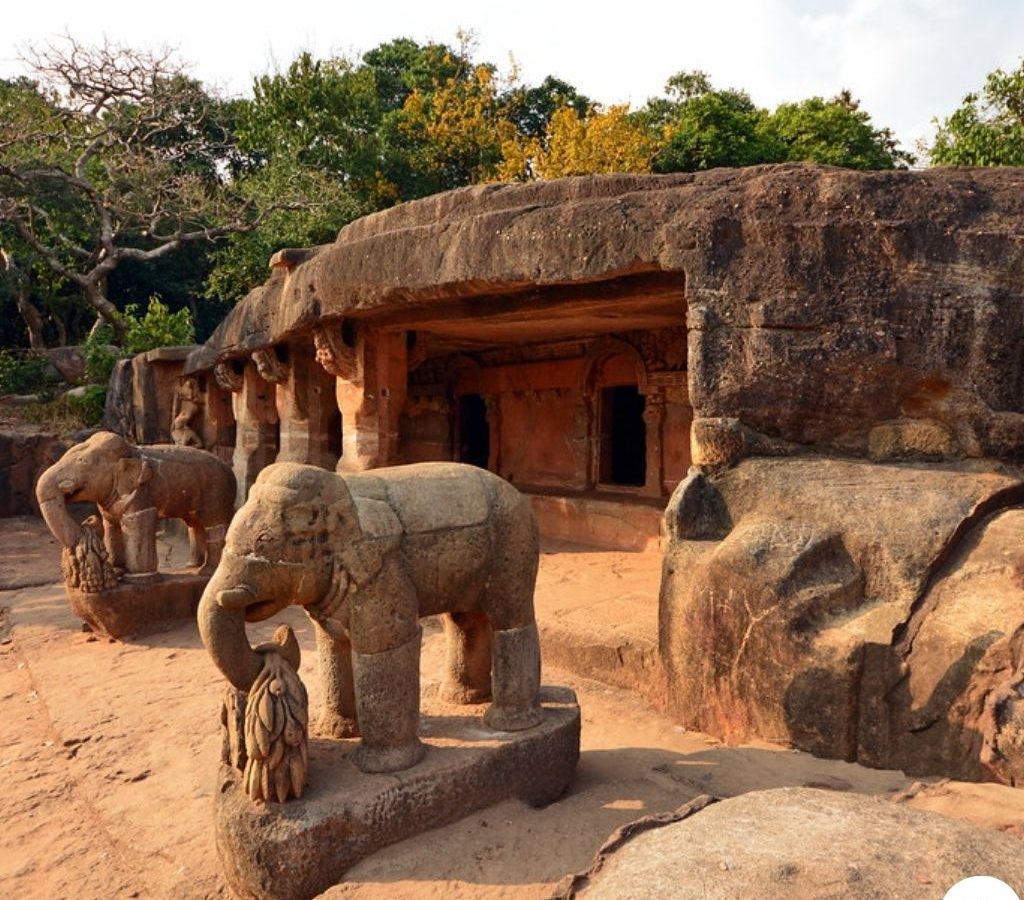
3. Ganesa Gumpha (Cave 10)
- Contains sculptures of elephants and Jain symbols.
- The carvings show elephants carrying garlands and offerings — a recurring motif of the period.
4. Bagh Gumpha (Cave 12) – The Tiger Cave
- Its entrance resembles the mouth of a tiger, giving it the name “Bagh Gumpha.”
- Possibly used as a meditation cell by monks.
5. Jaya Vijaya Gumpha (Cave 5)
- Twin caves with ornate pillars and reliefs.
- Dedicated to Jain spiritual ideals of enlightenment and liberation.
The Hathi Gumpha inscription is the most significant epigraphical record at the site.
- Written in Prakrit language using early Brahmi script.
- It provides detailed information about King Kharavela’s reign, including his military expeditions, cultural achievements, and public welfare measures.
- Mentions his patronage of Jain monks, construction of public infrastructure, and restoration of the city of Kalinga.
Other minor inscriptions found in various caves record the names of donors, monastic leaders, and religious endowments.
The Udayagiri and Khandagiri Caves hold profound importance in Jainism.
- They represent some of the earliest material evidence of Jain monastic life in India.
- The caves were inhabited by monks following the Digambara tradition, emphasizing asceticism and detachment.
- Carvings of Tirthankaras, Yakshas, and Yakshinis appear in several caves.
The site remains a pilgrimage destination for Jains, particularly during Mahavir Jayanti and other religious observances.
- Location: 6 km west of Bhubaneswar, Odisha
- Managed by: Archaeological Survey of India (ASI)
- Visiting Hours: 9:00 AM – 5:00 PM (Closed on Fridays)
- Entry Fee: ₹25 (Indian visitors), ₹300 (foreign visitors)
- Best Time to Visit: October to February
How to Reach:
- By Air: Biju Patnaik International Airport, Bhubaneswar (6 km)
- By Rail: Bhubaneswar Railway Station (7 km)
- By Road: Easily accessible via NH-16 and local transport.
Nearby attractions include the Lingaraj Temple, Dhauli Shanti Stupa, Khandagiri Hill viewpoint, and the Odisha State Museum.
The Udayagiri and Khandagiri caves are protected monuments under the Archaeological Survey of India (ASI).
Regular conservation efforts include:
- Structural stabilization of rock surfaces.
- Cleaning of inscriptions and sculptures.
- Erosion control and visitor management.
The site is also a part of the Odisha Heritage Circuit, promoted by the Ministry of Tourism, Government of India.
Due to its cultural and historical significance, the site has been proposed for inclusion in the UNESCO World Heritage List.
The Udayagiri and Khandagiri Caves remain a living testimony to ancient India’s religious tolerance, artistic innovation, and spiritual depth. Their rock-cut sculptures, inscriptions, and serene natural setting continue to attract historians, pilgrims, and tourists from across the world.
Udayagiri Fort (Tamil Nadu)
➡️Udayagiri Fort is a historic hill fort located near Padmanabhapuram in Kanyakumari district, Tamil Nadu, India. It stands as a significant remnant of the Travancore Kingdom’s military architecture and has strong historical ties to the reign of Marthanda Varma (1729–1758 CE), one of Travancore’s most powerful rulers.
Location and Geography
➡️The fort is situated about 14 km from Nagercoil and approximately 2 km from Padmanabhapuram Palace, nestled at the foot of the Western Ghats. The region is surrounded by dense vegetation and small hill ranges, making it both a naturally defended and scenic location.
Historical Background
➡️The original structure of Udayagiri Fort is believed to date back to the 17th century, during the rule of the Venad kings. It was later renovated and strengthened by King Marthanda Varma in the 18th century to serve as a major strategic and military outpost of the Travancore Kingdom.
➡️During this period, the fort was a center for training soldiers, manufacturing armaments, and housing prisoners of war. The fort also witnessed several significant historical events, including the military campaigns led by the Dutch East India Company in southern India.
Constructed primarily using granite blocks, Udayagiri Fort exhibits a blend of indigenous and European defensive architectural styles. The walls are massive, with bastions and watchtowers at strategic intervals.
Inside the fort, there are remnants of:
- Weapon foundries and smithy workshops, where cannons and ammunition were once manufactured.
- Underground tunnels and secret chambers, believed to be used for storing arms and supplies.
- A small palace complex, now mostly in ruins.
The fort complex also contains a foundry where Belgian engineer Eustachius De Lannoy, a former Dutch naval officer, was imprisoned after his defeat and later served as the chief of Travancore’s army.
One of the fort’s most famous associations is with Captain Eustachius De Lannoy, the Dutch officer who was captured by King Marthanda Varma after the Battle of Colachel (1741). De Lannoy was later pardoned and employed as a military advisor and trainer for the Travancore army.
He modernized the kingdom’s forces with European techniques, transforming them into one of the most formidable armies in South India. De Lannoy spent much of his life stationed at Udayagiri Fort, and his tomb still stands within the fort’s premises — a significant historical monument known as “De Lannoy’s Tomb.”
Today, Udayagiri Fort is maintained by the Department of Archaeology, Government of Tamil Nadu. The fort area, spanning over 90 acres, has been developed into a protected archaeological site and eco-park.
Visitors can explore:
- The fort ruins, walls, and bastions
- De Lannoy’s Tomb and chapel
- A botanical garden and small zoo maintained by the Forest Department
Due to its serene environment, historical value, and scenic backdrop of the Western Ghats, Udayagiri Fort has become a popular tourist attraction in Kanyakumari district.
Udayagiri Fort symbolizes the military prowess and modernization of the Travancore Kingdom during the 18th century. It also stands as a unique testament to Indo-European collaboration, represented by the alliance between King Marthanda Varma and De Lannoy.
The fort continues to be a heritage site of regional pride, attracting historians, tourists, and heritage conservationists interested in South Indian military architecture and colonial interactions.
Udayagiri Fort (Andhra Pradesh)
➡️Udayagiri Fort (also known simply as Udayagiri) is a historic hill fort located near Nellore district in the state of Andhra Pradesh, India. Rising majestically to about 3,000 feet (914 meters) above sea level, it stands as a monumental testament to South Indian medieval architecture, strategic fortification, and the region’s rich dynastic history.
Location and Geography
➡️Udayagiri Fort is situated approximately 100 km from Nellore city, near the town of Udayagiri. The fort occupies a massive hill of the Eastern Ghats, surrounded by dense forests and rocky slopes, offering natural defense and panoramic views of the surrounding plains.
➡️The hill and the fort together cover nearly 500 acres, making it one of the largest and most inaccessible forts in South India during its time.
The history of Udayagiri Fort spans several centuries and dynasties. It was originally established by the Pallavas and later fortified by subsequent rulers, including the Cholas, Nayakas, and Vijayanagara kings.
- Pallava Period (5th–9th centuries CE): Udayagiri served as a minor stronghold under Pallava rule, primarily for defense and administration.
- Chola and Pandya Rule (9th–13th centuries CE): The site gained prominence as a regional administrative center.
- Vijayanagara Empire (14th–16th centuries CE): Udayagiri reached its zenith under King Krishnadevaraya (r. 1509–1529 CE). He captured the fort from the Gajapati rulers of Odisha in 1512 CE after a fierce battle.
Under Krishnadevaraya’s rule, Udayagiri became an important strategic outpost and religious center of the Vijayanagara Empire.
The Udayagiri Fort complex features a multi-tiered structure with seven fortification walls, numerous gateways, and watchtowers constructed on the steep hillside. The architecture reflects a blend of Hindu and Islamic influences, typical of the Vijayanagara period.
Notable architectural features include:
- Temples: Several ancient shrines dedicated to Hindu deities, such as Lord Ranganayakaswamy, Lord Hanuman, and Lord Balaji, dot the hilltop and lower terraces.
- Palaces and Halls: Ruins of royal residences, audience halls, and granaries suggest the fort once housed a thriving population.
- Water Systems: Ingenious rainwater harvesting and storage systems were built to sustain inhabitants during sieges.
- Mosques and Dargahs: Later rulers added Islamic monuments, showing the fort’s changing political landscape.
The fort’s strategic layout, with multiple inner enclosures, provided strong defensive advantages against invading armies.
Udayagiri Fort is not only a military monument but also a spiritual landmark. The hill is home to several ancient temples and cave shrines, some of which predate the fort itself.
Among them, the Ranganayaka Swamy Temple is the most significant. Built during the Vijayanagara period, it exhibits intricate Dravidian-style architecture with beautifully carved pillars, gopurams, and mandapas. The temple continues to attract devotees and pilgrims throughout the year.
After the decline of the Vijayanagara Empire in the 17th century, the fort came under the control of various regional powers — including the Nayakas, Arcot Nawabs, and later the British East India Company.
By the 19th century, Udayagiri Fort had lost much of its strategic importance and gradually fell into ruin. However, remnants of its walls, gateways, temples, and inscriptions still stand as silent witnesses to its glorious past.
Today, Udayagiri Fort is a protected monument under the Archaeological Department of Andhra Pradesh. Though much of the fort is in ruins, it remains a popular trekking and heritage tourism destination.
Visitors can explore:
- Ancient temples and sculptures scattered across the hill
- The ruins of fortifications and royal chambers
- Panoramic viewpoints offering scenic vistas of the Eastern Ghats
- Stone inscriptions and relics narrating the fort’s long history
Due to its remote location and elevation, reaching the fort requires a moderate trek, which adds to its allure for history enthusiasts and adventure travelers.
Udayagiri Fort (Andhra Pradesh) stands as an enduring symbol of South India’s medieval military genius, religious diversity, and dynastic struggles. It reflects the grandeur of the Vijayanagara Empire, the architectural ingenuity of the era, and the syncretic cultural fabric of southern India.
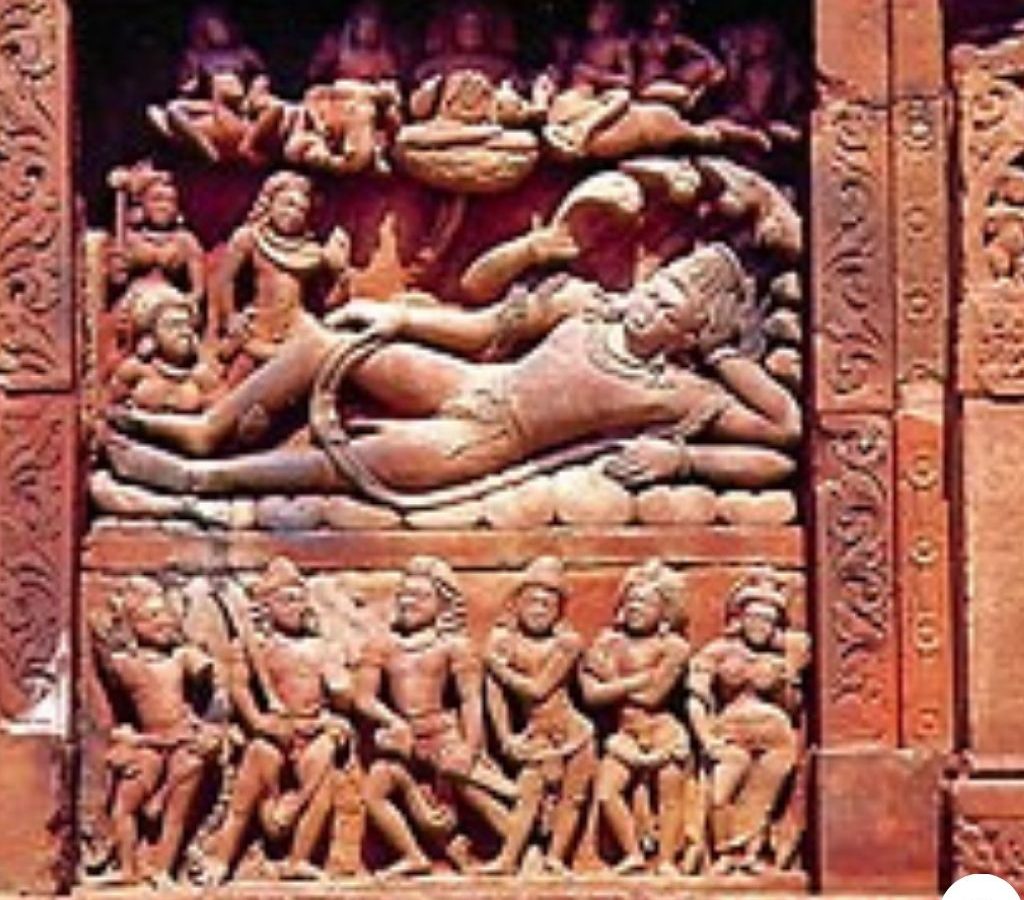
Udayagiri, Odisha
➡️Udayagiri, located near Bhubaneswar in the Khordha district of Odisha, India, is one of the state’s most significant archaeological and religious sites. Along with the nearby Khandagiri Hill, it forms the renowned Udayagiri and Khandagiri Caves complex, an exceptional example of ancient Jain rock-cut architecture dating back to the 2nd century BCE.
➡️This twin-hill complex stands as a living monument to Jain monastic life, ancient Indian art, and the early history of Odisha (then known as Kalinga).
Location and Geography
➡️Udayagiri Hill is situated approximately 6 km from the center of Bhubaneswar, adjacent to Khandagiri Hill, along the Bhubaneswar–Koraput Highway (NH-16).
➡️The word Udayagiri translates to “Hill of Sunrise”, symbolizing illumination and spiritual awakening — themes deeply connected with Jain asceticism. The hill rises to a moderate height and is dotted with caves, sculptures, inscriptions, and ancient stairways, all carved into the sandstone outcrop.
The Udayagiri hill complex was established during the reign of King Kharavela of the Chedi (Cheda) dynasty, who ruled Kalinga in the 1st century BCE. His reign is chronicled in the famous Hathigumpha Inscription, engraved on the rock face of Udayagiri itself.
Kharavela was a devout follower of Jainism, and under his patronage, the site became a major Jain monastic and pilgrimage center. The caves were excavated and inhabited by Jain monks, serving as places for meditation, study, and ascetic living.
The Udayagiri and Khandagiri Caves together contain 33 rock-cut chambers, of which 18 are in Udayagiri and 15 in Khandagiri.
The Udayagiri caves are carved directly into the sandstone hills and represent one of the earliest forms of Indian rock-cut architecture.
Notable Caves in Udayagiri
- Rani Gumpha (Queen’s Cave) – The largest and most elaborate cave in the complex, featuring two stories with intricately carved pillars, arches, and relief sculptures depicting royal processions, dancers, and elephants.
- Hathi Gumpha (Elephant Cave) – Known for the Hathigumpha Inscription of King Kharavela, one of the most important historical records of ancient Odisha.
- Ganesh Gumpha – Features carvings of elephants and images of Ganesha, indicating later additions by Hindu devotees.
- Jaya-Vijaya Gumpha – Distinguished by its ornamental facades and carved dwarapalas (door guardians).
- Vyaghra Gumpha – Shaped like a tiger’s mouth, symbolizing protection and ascetic isolation.
The caves display sculptural themes from Jain mythology, royal life, and nature — all executed with remarkable realism for their time.
The Hathigumpha Inscription, carved on the wall of Udayagiri, is a 17-line Prakrit record written in Brahmi script. It provides invaluable insight into the life and achievements of King Kharavela, describing his military conquests, public works, religious tolerance, and devotion to Jainism.
It is considered one of the most significant epigraphic sources for reconstructing early Indian and Odishan history.
Udayagiri holds profound importance for Jainism, being one of the earliest centers of Jain ascetic culture in eastern India. The caves served as monastic retreats for Jain monks who practiced Sallekhana (ritual fasting) and meditative austerity.
Over centuries, the site also attracted Hindu devotees, and some caves bear traces of later Hindu iconography, demonstrating the syncretic religious evolution of the region.
Today, annual Jain festivals and heritage celebrations are held here, particularly during Mahavir Jayanti, attracting pilgrims and historians alike.
Extensive archaeological work at Udayagiri has been carried out by the Archaeological Survey of India (ASI). Excavations and conservation efforts have revealed:
- Ancient drainage and water systems used by monks.
- Sculptural remains depicting royal patrons and celestial beings.
- Inscriptions referencing Jain monks, patrons, and dynastic names.
The site is now protected as a Monument of National Importance, ensuring ongoing preservation and documentation.
Udayagiri, together with Khandagiri, is one of the most visited heritage sites in Odisha. The site is open daily and managed by the ASI and Odisha Tourism Department.
Tourists can explore:
- The rock-cut caves and carvings
- The Hathigumpha inscription viewpoint
- The sunrise panorama over Bhubaneswar city
- The Khandagiri-Udayagiri hill trail, a popular short trek for heritage enthusiasts
Interpretation boards and light pathways have been added to enhance visitor experience while preserving the site’s sanctity.
Udayagiri, Odisha, stands as a symbol of Jain devotion, early Indian architecture, and the cultural unity of Kalinga. Its caves, inscriptions, and sculptures provide rare insight into India’s 2nd century BCE religious life, royal history, and artistic innovation.
The site continues to inspire historians, archaeologists, and spiritual seekers — serving as a timeless reminder of India’s ancient heritage.
Udayagiri, Madhya Pradesh
➡️Udayagiri, located near Vidisha in the Madhya Pradesh state of central India, is one of the most important archaeological, religious, and artistic sites from the Gupta period (4th–6th centuries CE).
➡️Renowned for its rock-cut caves, Hindu and Jain sculptures, and the celebrated monolithic image of Lord Vishnu as Varaha (the Boar Avatar), Udayagiri stands as a classic representation of early Indian temple art and iconography. It is one of the oldest surviving Hindu cave sites in India and provides key insights into the religious and political landscape of the Gupta Empire.
Location and Geography
➡️The Udayagiri hill lies approximately 6 km west of Vidisha and 13 km from Sanchi, in the Raisen district of Madhya Pradesh.
➡️The site comprises a group of twenty rock-cut caves excavated on the slopes of a sandstone hill overlooking the Betwa River valley. The hill’s name, meaning “Hill of the Sunrise,” reflects its eastward orientation — symbolically associated with light, life, and divine illumination.
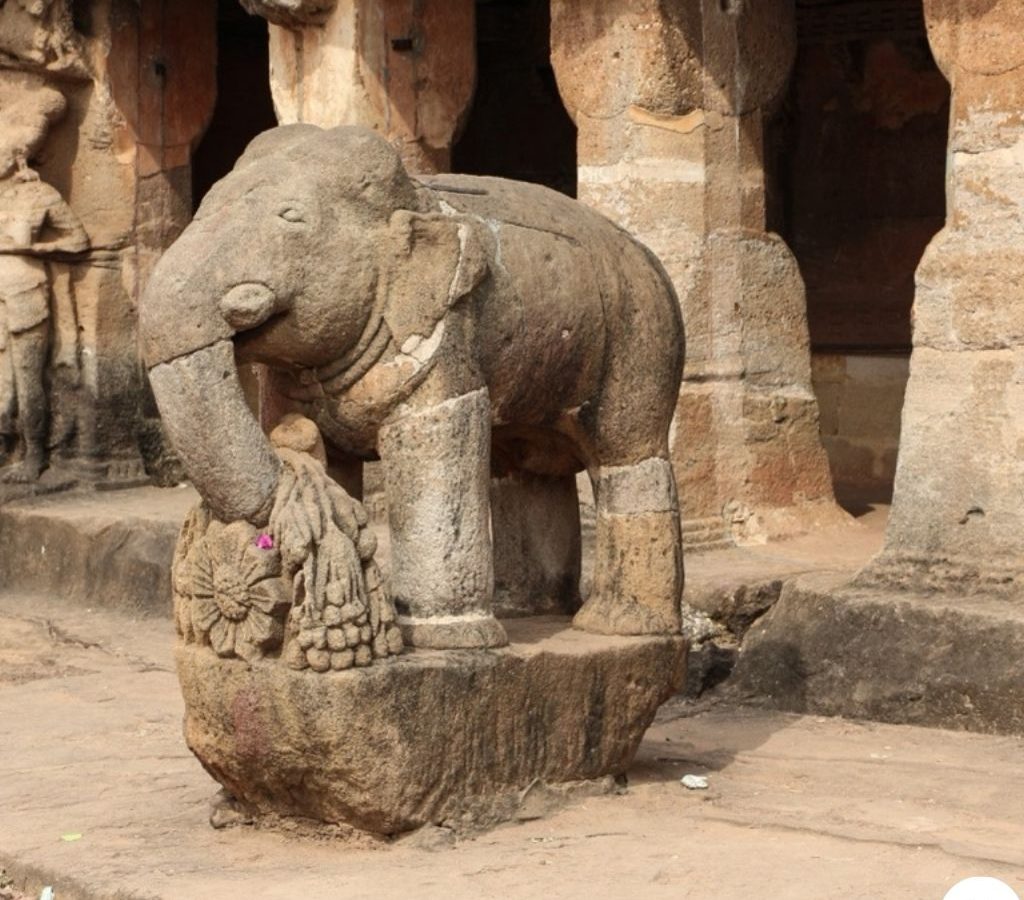
The Udayagiri caves date primarily to the early 5th century CE, during the reign of Chandragupta II (Vikramaditya) of the Gupta dynasty.
Inscriptions found at the site mention the minister Virasena, who supervised the construction and consecration of several caves. The caves were dedicated to Hindu deities (mainly Vishnu and Shiva) and served as monastic retreats for ascetics.
The complex also shows traces of earlier Jain occupation, indicating that Udayagiri may have been a shared religious site over different periods.
Udayagiri holds exceptional historical value as it reflects the imperial patronage of art and religion under the Guptas, often called the “Golden Age of India.”
The Udayagiri complex contains 20 rock-cut caves numbered 1 to 20. These were carved into the hill’s sandstone face and vary in purpose — some being shrines, others hermitages, and a few serving as meditation chambers.
The caves exhibit transitional architecture between simple rock shelters and early temple-style structures. Characteristic features include:
- Pillared verandahs and sanctum chambers (garbhagrihas).
- Relief carvings depicting scenes from Hindu mythology.
- Sanskrit inscriptions in Gupta Brahmi script, praising kings and gods.
Several caves at Udayagiri are of particular archaeological and artistic significance:
Cave 5 – Varaha Cave
- The most celebrated feature of Udayagiri, Cave 5 contains a colossal relief of Lord Vishnu as Varaha, rescuing the Earth goddess Bhudevi from the cosmic ocean.
- The Varaha panel, measuring over 7 meters wide, is among the finest examples of Gupta art, combining mythological depth with imperial symbolism — the Varaha representing Vishnu’s power and, allegorically, the king’s duty to uphold cosmic order.
Cave 6 – Shiva Shrine
- Contains a linga and images of Shiva and Parvati, along with narrative reliefs such as Ganga descending from heaven and Durga slaying Mahishasura.
- The cave also bears an inscription referring to the reign of Chandragupta II.
Cave 13 – Vaishnava Reliefs
- Features smaller carvings of Vishnu’s avatars and attendants.
- The style reflects early temple sculpture that influenced later medieval art in Central India.
Cave 19 – Jain Cave
- Houses a Jain Tirthankara relief, indicating the site’s religious diversity and possible co-existence of Jain and Hindu traditions.
Udayagiri’s inscriptions provide crucial data about the Gupta dynasty’s political geography and religious ideology.
One key inscription, attributed to Minister Virasena, records the dedication of a cave to Vishnu on behalf of King Chandragupta II.
Other inscriptions refer to royal donations, ascetic practices, and the cosmic significance of the site. Together, they affirm the Gupta kings’ role as divine rulers and protectors of dharma (cosmic order).
The art of Udayagiri represents the mature phase of Gupta sculpture, marked by:
- Graceful figures with naturalistic body forms.
- Compositional balance and symbolic storytelling.
- Harmonious blending of myth and political power.
The Varaha panel, in particular, symbolizes the Gupta vision of divine kingship, portraying Vishnu as the cosmic savior — paralleling the emperor’s role as the earthly preserver of order and prosperity.
Udayagiri’s iconography reveals the synthesis of Vedic, Puranic, and local traditions. The site demonstrates the emergence of temple-based Hindu worship, marking a key transition from Vedic ritualism to image-based devotion (bhakti).
Its coexistence with Jain shrines also illustrates the pluralistic religious environment of early historic India.
The Udayagiri complex is now a protected monument under the Archaeological Survey of India (ASI). Ongoing research, including laser mapping and 3D documentation, has helped preserve and interpret the site’s carvings.
Archaeologists have identified ancient water channels, ritual platforms, and alignment features suggesting that Udayagiri was planned according to astronomical and cosmological principles — possibly serving as a solar observatory and ritual landscape.
Located near Sanchi and Vidisha, Udayagiri is a popular stop on the Central India heritage circuit. The site is accessible by road and rail from Bhopal (60 km).
Visitors can explore:
- The Varaha Cave and surrounding sculptures.
- Sunrise viewpoints and rock-cut trails.
- Informational plaques provided by ASI.
The site is best visited during early morning or late afternoon when the carvings are illuminated by natural sunlight, enhancing their visual depth.
Udayagiri, Madhya Pradesh, stands as one of the most important Gupta-era archaeological sites in India. It represents the intersection of art, religion, astronomy, and imperial ideology, capturing a moment when Indian civilization reached new heights of cultural sophistication.
The site continues to inspire scholars, artists, and spiritual seekers as a symbol of cosmic vision and artistic excellence in ancient India.
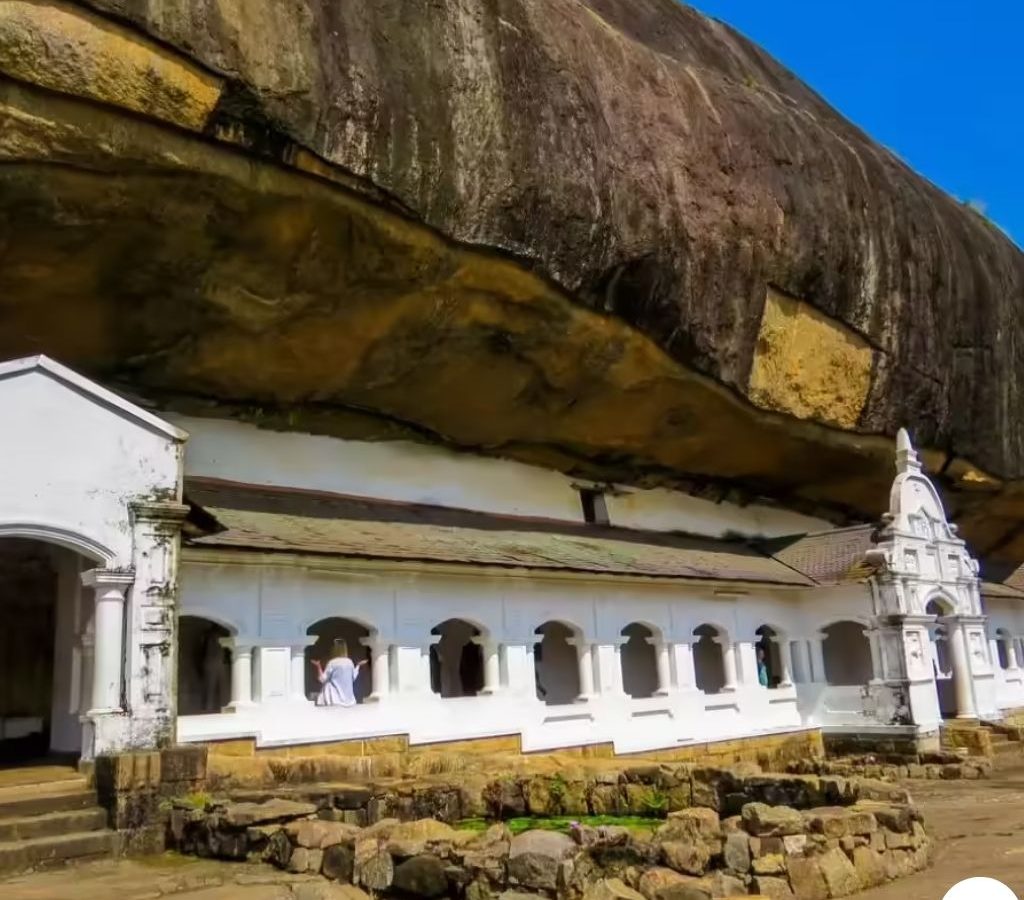
Other Places Named Udayagiri
➡️Apart from the major historical and archaeological sites in Odisha, Madhya Pradesh, Andhra Pradesh, and Tamil Nadu, the name “Udayagiri” appears in several other regions across India. These lesser-known sites, villages, and hills reflect the cultural continuity and spiritual symbolism associated with the term — meaning “Hill of Sunrise” or “Mountain of Rising Light.”
➡️The recurring use of the name throughout India underscores its religious, geographical, and poetic appeal, often linked to locations of natural elevation, temples, or ancient settlements.
Udayagiri, Karnataka
➡️In the city of Kalaburagi (Gulbarga), northern Karnataka, the term Udayagiri refers to a hill and fort complex that holds both Hindu and Islamic monuments.
➡️The Udayagiri Fort, Kalaburagi, dates back to the Bahmani Sultanate period (14th–15th centuries CE).
➡️The site houses mosques, tombs, and defensive walls, and served as an important military outpost under Sultan Ala-ud-Din Bahman Shah.
Later additions were made by the Adil Shahi rulers of Bijapur, making it a historically layered site of Deccan Sultanate architecture.
Apart from the main Udayagiri Fort near Nellore, the surrounding region also contains several small villages and temple sites bearing the same name.
- These smaller Udayagiri settlements were likely established by monks or military garrisons associated with the main fort.
- Inscriptions found in nearby areas refer to “Udayagiri Nadu”, a term that once designated an administrative division under the Vijayanagara Empire.
In Kannur district of northern Kerala, Udayagiri is the name of a village and hill area known for its ancient Jain ruins and later Hindu temples.
- Archaeological remains include Jain bas-reliefs, stone idols, and carved platforms dating back to the 9th–12th centuries CE, suggesting the presence of Jain settlements in the region.
- Over time, the site became associated with local Hindu traditions, and several shrines dedicated to Bhagavati and Shiva were constructed.
The Udayagiri hill now serves as a heritage and eco-tourism destination, known for its scenic forest trails and hilltop viewpoints.
In Maharashtra, the name appears in several localities and Buddhist cave records.
- Near Aurangabad, early Buddhist sites like Ajanta and Ellora contain epigraphic references to a place named Udayagiri, which may have denoted a monastic hill settlement during the Satavahana and Vakataka periods (2nd–5th centuries CE).
- Though the precise location is debated among archaeologists, it highlights the pan-Indian use of the name Udayagiri in religious geography.
In the Puranic and later Sanskrit texts, the term Udayagiri is sometimes used to describe mythical or symbolic mountains located in the eastern direction, representing the place of sunrise or divine emergence.
- Some later medieval chronicles of Tripura and Assam mention a Udayagiri Parvat as a sacred peak associated with Surya (the Sun God).
- These references are largely literary and cosmological, reinforcing the name’s spiritual symbolism rather than a specific geographical site.
Today, numerous villages, administrative blocks, and local councils in states like Andhra Pradesh, Odisha, Karnataka, and Kerala carry the name Udayagiri.
Examples include:
- Udayagiri Mandal, an administrative division in Nellore district, Andhra Pradesh.
- Udayagiri Panchayat, a local self-government body in Kannur district, Kerala.
- Udayagiri village, near Tirupati, known for its small Shiva temple and agricultural heritage.
These widespread occurrences underline the popularity of the term in South Indian culture, particularly in regions influenced by Sanskritized place-naming traditions.
Across all these sites — whether historical forts, temple hills, or modern villages — the name Udayagiri carries deep symbolic meaning.
It embodies ideas of:
- Light and renewal (linked with the sunrise and spiritual awakening)
- Elevation and sanctity (hills as abodes of gods or monks)
- Continuity of civilization (many sites showing cultural overlap between Jain, Hindu, and Buddhist traditions)
Thus, Udayagiri has transcended geography to become a spiritual and cultural archetype, appearing repeatedly in India’s religious, literary, and administrative history.
Cultural and Symbolic Legacy of Udayagiri Across India
The name Udayagiri, literally meaning “Hill of the Rising Sun” (from Udaya – rising, and Giri – hill or mountain), carries deep cultural, spiritual, and historical symbolism across India. Found in multiple regions — from Odisha and Madhya Pradesh to Andhra Pradesh and Tamil Nadu — the term embodies the interplay of geography, religion, and history, serving as a unifying motif of India’s ancient civilizational identity.
The recurring presence of Udayagiri across India’s geography reflects more than coincidence — it signifies the continuity of India’s sacred geography, artistic evolution, and historical consciousness.
Whether as a hill of enlightenment, a fort of valor, or a site of artistic excellence, Udayagiri remains a timeless emblem of India’s rising spirit — a hill where dawn, devotion, and destiny converge.
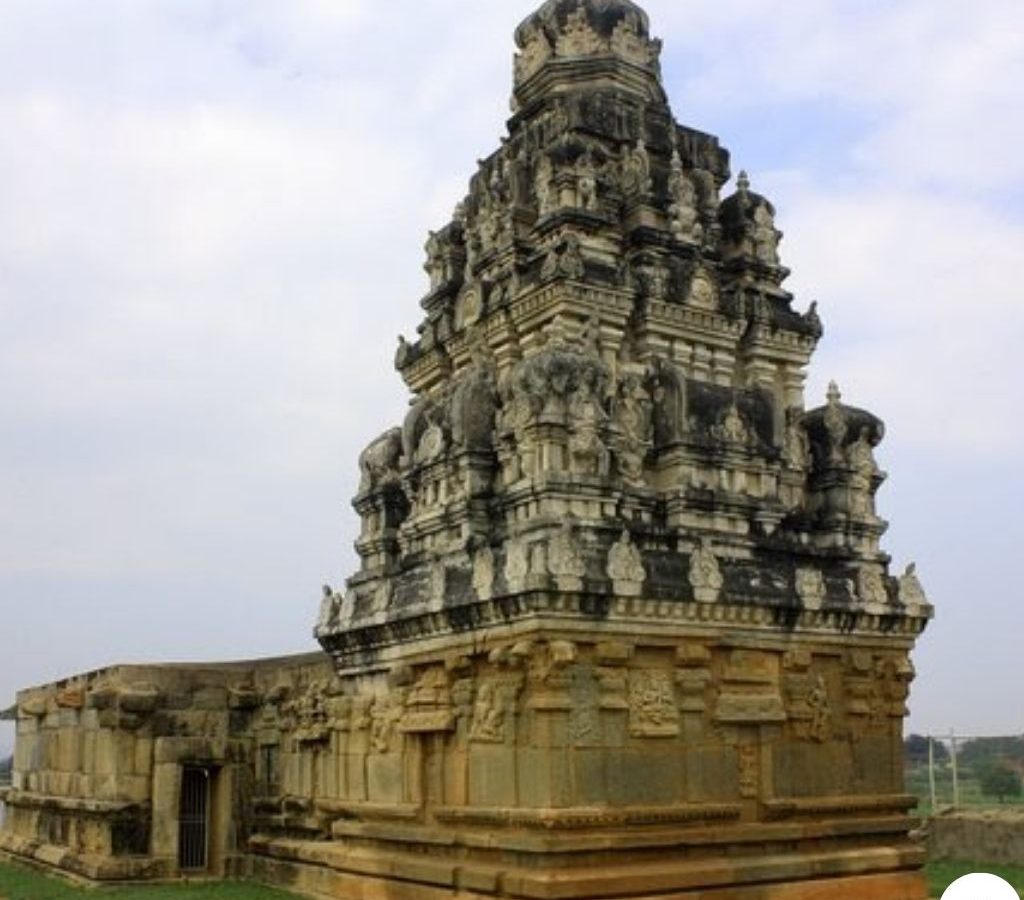
Udayagiri’s association with the “rising sun” holds a sacred resonance in Indian cosmology. The concept symbolizes enlightenment, rebirth, and divine illumination, recurring in Hindu, Jain, and Buddhist traditions.
- In Odisha, the Udayagiri and Khandagiri Caves represent early Jain monastic centers, carved to honor spiritual asceticism and the pursuit of liberation (moksha).
- In Madhya Pradesh, the Udayagiri Caves near Vidisha are associated with Gupta-era Hindu iconography, featuring some of the earliest known depictions of Lord Vishnu’s Varaha avatar, emphasizing the cosmic victory of good over evil.
- Across South India, forts named Udayagiri reflect the symbol of dawn and defense, linking spiritual awakening with the rise of political power and protection.
Thus, Udayagiri as a name transcends geography — becoming a spiritual metaphor for emergence and illumination.
The art and architecture found in the various Udayagiri sites showcase the diverse yet interconnected regional expressions of Indian civilization. From rock-cut cave carvings and stone inscriptions to temple sculptures and fortifications, each Udayagiri reflects the cultural essence of its time and region.
- The Gupta-period carvings at Udayagiri (Madhya Pradesh) mark a high point in classical Indian sculpture, influencing later temple art in central and northern India.
- The Jain iconography at Udayagiri and Khandagiri (Odisha) influenced religious architecture across eastern India, serving as prototypes for later rock-cut sanctuaries.
The forts of South India bearing the same name, such as in Tamil Nadu and Andhra Pradesh, demonstrate the fusion of local architectural practices with strategic design, symbolizing India’s evolving heritage through the medieval era.
Across centuries, Udayagiri has remained a marker of cultural continuity. Despite regional variations, the name appears consistently in inscriptions, travelogues, and royal chronicles, suggesting that Udayagiri was more than a location — it was an idea.
It symbolized:
- The rising of dynasties and spiritual traditions
- The fusion of faith and art in rock-cut monuments
- The resilience of ancient Indian heritage through time
From the Mauryan to Gupta empires, from Jain monasticism to Hindu temple traditions, the repeated emergence of “Udayagiri” across regions underscores a shared cultural vocabulary within India’s vast historical landscape.
In the present day, Udayagiri continues to be celebrated as a symbol of India’s ancient glory and spiritual diversity. The archaeological sites are now protected heritage zones under the Archaeological Survey of India (ASI), drawing historians, scholars, and tourists alike.
These sites collectively serve as:
- Educational centers for research in art, religion, and history
- Tourist attractions that promote cultural awareness and heritage conservation
Symbols of national pride, reflecting India’s layered civilization and pluralistic traditions
References
- Archaeological Survey of India (ASI) – Annual Reports on Indian Epigraphy and Monuments of National Importance, Government of India Publications.
- ASI Official Website – https://asi.nic.in
- “The Gupta Empire and Its Art” – R. C. Majumdar, The History and Culture of the Indian People, Volume III, Bharatiya Vidya Bhavan, Mumbai.
- “Rock-Cut Architecture in Ancient India” – Percy Brown, Indian Architecture: Buddhist and Hindu Periods, D. B. Taraporevala Sons & Co.
- “Jain Antiquities of Odisha” – K. C. Panigrahi, Journal of the Asiatic Society of Bengal, Archaeological Series.
- Archaeological Survey of India, Bhubaneswar Circle – Reports on Udayagiri and Khandagiri Caves, Odisha.
- Government of India Tourism Portal – Incredible India Official Website: https://www.incredibleindia.org
- Department of Archaeology, Tamil Nadu – Protected Monuments List: Udayagiri Fort, Kanyakumari District.
- Andhra Pradesh Tourism Development Corporation (APTDC) – Udayagiri Fort and Nellore District Tourism Guide.
- Indian Archaeology: A Review – Annual Publications, Archaeological Survey of India.
- Epigraphia Indica – Volumes on Gupta and Post-Gupta inscriptions referring to Udayagiri, Vidisha.
- Odisha Tourism Department – Heritage Monuments and Caves of Bhubaneswar and Surroundings.
- National Museum, New Delhi – Catalogue of Gupta Sculpture from Udayagiri and Vidisha Region.
- Local Histories of Travancore – V. Nagam Aiya, The Travancore State Manual, 1906.
- UNESCO World Heritage Tentative List of India – Entries concerning Udayagiri and Khandagiri Caves, Odisha.